How high are the actual emissions, once all factors are taken into account and compared with normally accepted thresholds?
In the 3D printing community it’s common to hear warnings related to printing ABS at home and suggestions about venting the fumes outside with a direct hose, using active carbon filters to adsorb VOCs, and so on.
But how dangerous is it really, once we take everything into account?
ABS is known to release, among other compounds, styrene, which is linked to development of cancer. The International Agency for Research on Cancer (IARC, part of the WHO) reclassified it in 2018 from “possibly carcinogenic” (Group 2B) to “probably carcinogenic” (Group 2A). This classification describes how strong the evidence is that a substance can cause cancer, not how potent it is at a given dose. Biology doesn’t work as “yes/no”: concentration levels matter, and likewise exposure time matters.
Styrene is not the only emission. ABS also releases small amounts of acrylonitrile (upgraded by IARC to Group 1, “carcinogenic to humans”, in 2024) and large numbers of ultrafine particles. This article quantifies styrene, for which emission data and health-based limits exist, and discusses the other emissions at the end.
A conservative scenario
We should consider the following aspects:
- styrene emission rate of the printer
- removal of styrene from the room by ventilation
- time spent by the person in the room
- duration of the emission
- health-based limits for inhalation
The scientific article “Summary and derived Risk Assessment of 3D printing emission studies” (public access) describes the results of a meta-analysis of other scientific papers on the topic. It mentions damages in cells due to the emissions from 3D printers. Styrene is discussed, and it is also mentioned that according to some studies PLA particles, due to their smaller size, cause more damage per particle. This does not make PLA worse overall: ABS typically emits many more particles, often one to two orders of magnitude more.
The article publishes this figure with typical Styrene emissions in the range between approximately 10 µg/min to 115 µg/min during printing:
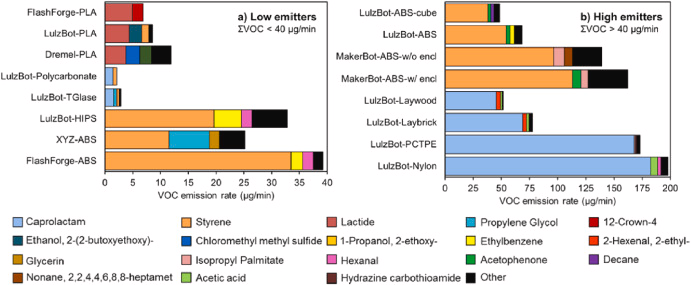
No further information is provided about which filaments are usually high emitters and which ones are low emitters, nor whether the values are typical or maximum ones, so the upper end is not necessarily a worst case.
We will take the highest value (115 µg/min) as baseline. The article predates the rise of modern (fast) 3D printers (which became widespread one year later), which extrude several times more material per hour, often at higher nozzle temperatures. Since emissions scale roughly with the amount of material extruded, we will also consider twice that value, 230 µg/min, for a fast printer.
If the printer is located in a 3×4 m room with a 2.65 m ceiling (a home office or bedroom), that’s a volume of 31.8 m³. Assuming the air in the room is well mixed, the concentration settles at the value where emission and removal by ventilation balance each other:
where E is the emission rate, n the number of air changes per hour (ACH) and V the room volume.
How much ventilation should we assume? With windows closed, modern homes typically have 0.2-0.5 air changes per hour, and ventilation standards such as ASHRAE 62.2 target roughly 0.35 ACH. Older, leakier homes or rooms with mechanical ventilation can reach 1 ACH or more. The resulting steady-state concentrations are:
| Emission | 1 ACH | 0.5 ACH | 0.3 ACH |
| 115 µg/min | ~220 µg/m³ | ~430 µg/m³ | ~720 µg/m³ |
| 230 µg/min (fast printer) | ~430 µg/m³ | ~870 µg/m³ | ~1,450 µg/m³ |
How long would the exposure last? Two factors reduce the actual exposure considerably:
- A print does not last forever. The concentration approaches the values in the table with a time constant of 1/n: at 0.3 ACH this is 3.3 hours, so at the end of a 2-hour print the concentration has reached only about 45% of the table value. Only very long prints get close to it.
- Chronic health limits assume continuous exposure, 24 hours a day for a lifetime. Even with a printer running all the time (a very unrealistic scenario), a person spending 8 hours per day in the room receives a time-weighted average of one third of the room concentration.
On the other hand, the concentration close to the printer can be several times higher than the room average, so sitting right next to it for hours makes things worse.
The document Styrene – A Common Air Pollutant lists the recommended exposure thresholds (residential and occupational) as provided by various health and safety entities from US and Europe. For long-term exposure of the general population:
- US EPA reference concentration: 1,000 µg/m³
- ATSDR chronic minimal risk level: about 850 µg/m³
- California OEHHA chronic reference exposure level: 900 µg/m³
- WHO air quality guideline: 260 µg/m³ (weekly average)
- German indoor air guide values (Ausschuss für Innenraumrichtwerte): 30 µg/m³ (RW I, precautionary: no effects expected even with lifelong exposure) and 300 µg/m³ (RW II, action value: measures should be taken)
The limit set by the German “Ausschuss zur gesundheitlichen Bewertung von Bauprodukten” is not listed because it applies to emissions from building products, not to indoor air quality.
Occupational limits are much higher (for example 10 ppm, about 43 mg/m³, for the ACGIH TLV), but they are designed for healthy adult workers exposed 40 hours per week and are not appropriate for a home, where children, pregnant people or the elderly may be present.
Comparing the table with these limits:
- a slow printer in a room with 1 ACH stays below all of them, except the German precautionary value;
- with windows closed and low ventilation, and especially with a fast printer, the steady-state concentration exceeds the WHO guideline and the German action value, and approaches or exceeds the US values;
- with time-weighting, even the worst case (about 1,450 µg/m³) corresponds to about 480 µg/m³: below the US values, but still above the WHO guideline and the German action value.
Summary
We used a conservative scenario: long prints in a relatively small room, with a person spending 8 hours a day inside.
For a single hobby printer, styrene exposure under typical use (finite prints, a room not used for sleeping, airing after printing) is likely below most health-based limits for indoor air. In a small, poorly ventilated room with a fast printer running for long periods, it can approach or exceed the stricter ones (WHO, German action value).
It is reasonable to conclude that styrene from ABS is not a reason to panic, but also not something to ignore completely: simple measures are enough to keep it low.
Beyond styrene
Ultrafine particles: ABS is consistently among the highest emitters. They have no smell and no health-based limit exists, so they cannot be assessed as above, but they are probably the main open question.
Acrylonitrile: emitted in much smaller amounts than styrene, but classified as carcinogenic, so it is a further reason to keep emissions low.
The simple measures are: don’t print in the room where you sleep, use an enclosure with HEPA (particles) and activated carbon (VOCs) filtration or exhaust it outside, and air the room after printing. A direct hose to the outside is a good option, but not a necessity.
Some practical cases
An old i3-style printer such as old Ender 3’s, Prusa MK3, Prusa Mini: these printers are by today standards very slow, so they emit less. ABS can be printed on them, but it warps more, so low-warp blends are often used. In my experience some of them, for example Polymaker ABS, barely smell (less than some PLA). Styrene has a low odour threshold, so a weak smell suggests low styrene emissions, but it is not proof: our nose adapts quickly, and ultrafine particles have no smell at all. Low risk here, especially if the room is aired after printing.
A similar old printer, but inside an enclosure: an enclosure alone does not remove pollutants, it only delays their release, and opening it at the end of the print releases what accumulated inside. Waiting some time before opening it and ventilating the room by opening windows should be enough. A recirculating filter with HEPA and activated carbon actually removes them.
A modern and fast printer (for example, but not exclusively, those with a maximum speed above 500 mm/s or using “Klipper” as firmware): if it’s not enclosed, it emits more than the old ones, so the fast printer row of the table applies: ventilate well and avoid long prints in small closed rooms where you spend time. If enclosed, the emissions inside can be intense, but the enclosure contains most of them during the print. This is my case, for example: the air inside the enclosure is not vented until the end of the print, then I ventilate the room. For frequent printing, a filter inside the enclosure or an exhaust to the outside is the best option.
Ventilating the room means 5-10 minutes of windows wide open, ideally on opposite sides of the room or house.
Addendum: Energy loss by opening the windows
I find online people complaining about ABS smell and refusing to open windows because of the energy losses in winter, or the need for extra cooling in summer. But is this really making any difference? not really, and this is why.
First of all, opening windows for 5-10 minutes won’t cool or heat the furniture or walls significantly, their mass is simply too big. Only the air in the room will be replaced with the external one.
This calculation is adapted from this post in Reddit.
Let’s say you replace in summer all the air inside the room (20 °C) with hot air (35 °C), how much energy will it cost to cool it down to 20 °C again?
The same room as above, 3×4 m with a 2.65 m ceiling, has a volume of 31.8 m³. Mass density of air is approximately 1.225 kg/m³ which multiplied by 31.8 gives a total mass of 39 kg.
So we have 39 kg of air and want to cool the air from 35 °C to 20 °C. Let’s start with the easiest calculation: how much energy would we need to heat the air by the same temperature difference (the other way around, which would be the case of opening windows in winter)? We can use this formula:
ΔQ = m x ΔT x c
where ΔQ is the heat we need (the energy), m is the mass of the air, ∆T is the temperature change and c is the specific heat of air at constant pressure, 1.00 kJ/(kg*K). Plugging in the numbers gives an energy cost of:
ΔQ = m x ΔT x c = 39 x 15 x 1.0 = 585 kJ (kilojoules) of energy.
So the heating of the air needs 585 kJ. How expensive would that be? 1 kWh is 3,600 kJ, so 585 kJ is approximately 0.16 kilowatt hours, and with an electricity price of 0.30 €/kWh it costs 0.16 x 0.30 = 0.05 € to heat all that air with an electric heater. In winter the temperature difference is often larger (20-25 K), bringing it to about 0.06-0.08 €, and with a heat pump (COP 3-4) the cost is a third to a quarter of that.
So, for the case of opening windows in winter, and printing every day, it would be less than 2.5 € per month even with direct electric heating.
In summer it’s cheaper… the cooling process in airco’s can give a coefficient of performance of higher than 1. The theoretical limit for the temperatures we mentioned above is
where Tc is cold temperature, Th is hot, both measured in Kelvin. This means that for each Joule you put into the air conditioner, it can remove much more than 1 Joule of heat. So it would actually cost less to cool down the air than heating it up. A realistic COP is nowadays 3 or more, so in summer cooling the room would cost about 0.02 € per print.
TL;DR: So no, it isn’t expensive to ventilate a room after a 3D print.
Edit: as /u/TellMeYourButtStory pointed out, the calculations above assumed dry air. Water vapour barely changes the specific heat of air (a few percent), but in summer the air conditioner must also condense part of the moisture of the incoming air, and this latent heat can be as large as, or larger than, the sensible heat calculated above. Even tripling the summer cost, it stays around 0.05 € per print. TL;DR: So including these effects will not change the conclusion at all.